For Clinics, RCM Isn’t Just Back Office, It’s Mission Critical
Most clinics do not fail because of patient demand or care quality. They struggle because revenue is delayed, denied, or lost in the cracks between systems and people. When billing becomes the bottleneck, it’s not just finance that feels it. Clinical staff are forced to follow up on claims. Administrative teams work overtime to reconcile rejections. And leadership is stuck guessing what’s really causing the slowdown.
That’s why choosing an RCM billing provider is not a transactional decision. It is a strategic one.
Whether you’re a single-location practice or a fast-growing specialty group, the billing partner you choose will influence not only your cash flow but also your staffing, your reporting, and your ability to grow.
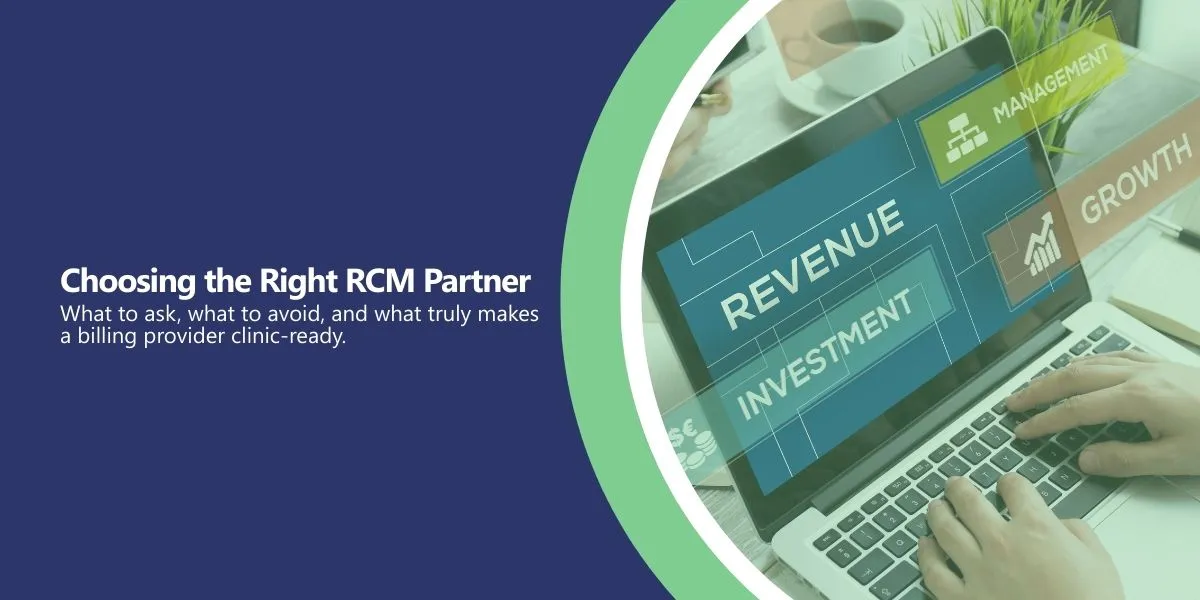
This article outlines what to look for, what to ask, and what to avoid when choosing an RCM provider built for clinics like yours.
Quick Summary: What You’ll Learn
- What sets a clinic-ready RCM provider apart from a generic billing vendor
- Six essential criteria to evaluate before signing a contract
- Common red flags that signal poor alignment
- How the right partnership improves both performance and visibility
What to Look for in an RCM Provider That Truly Supports Clinics
1. Experience With Similar Clinic Settings
Not all RCM vendors understand the realities of running a clinic. Some come from hospital backgrounds; others are built for large systems. Your billing partner should have direct experience with similar volumes, staffing models, and specialties. Ask for examples, not just logos.
2. Transparent Performance Reporting
You should not have to wait for quarterly summaries or interpret vague charts to understand your performance. Your vendor should offer real-time dashboards or at least clear weekly and monthly reporting. You need data on clean claim rates, denial reasons, AR days, and reconciliation trends. If reporting is manual or unclear, future issues will be harder to detect.
3. Full-Cycle Billing Support, Not Just Submission
Some vendors stop after the claim is submitted. But the real work often begins after that. A strong RCM partner will help with eligibility checks, prior authorizations, appeals, and denial resolution. They will not leave your staff to chase rejections or follow up on outstanding balances alone.
4. Integration With Your Existing Workflows
Your clinic has its own systems, documentation practices, and EHR. A clinic-ready billing partner won’t try to overwrite your operations. They will find ways to integrate into your process with minimal disruption. This includes aligning with your intake flow, your documentation cycle, and how your team communicates with patients.
5. Dedicated Point of Contact and Escalation Path
Billing issues are time-sensitive. A shared inbox or rotating account manager won’t cut it. You need a consistent point of contact who knows your clinic, your pain points, and your targets. Escalations should be structured, not improvised. If communication isn’t reliable, neither is the partnership.
6. Predictable, Transparent Pricing
Low upfront cost can be appealing, but unclear fees add up. Ask whether appeals, high-volume months, reporting, or integration support incur additional charges. Make sure the scope of work is clearly defined. A good RCM partner will explain what is included and what is not before you commit.
Questions to Ask Before You Sign
- What percentage of your clients are clinics of our size and specialty?
- Can you show sample performance reports we’d receive regularly?
- How do you handle denials and appeals?
- Who will be our day-to-day contact?
- How quickly can we get questions or escalations resolved?
- Are there additional fees for support beyond claim submission?
If the answers are vague, defensive, or overly generic, that’s a sign of poor fit.
Red Flags to Watch For
- Promises that feel too good to be true without proof
- Lack of experience with your systems or payer mix
- Delays in providing client references
- Little to no reporting infrastructure
- “We’ll figure that out later” when asked about integration
Final Thoughts: Look for Fit, Not Just Features
The best RCM partner for your clinic is not necessarily the one with the flashiest tools or the biggest team. It is the one that understands how your clinic operates, communicates clearly, delivers consistent results, and helps you improve, not just maintain, your revenue cycle.
When billing runs smoothly, your team can focus on patients. When it doesn’t, everything feels harder.
Choosing the right partner now can prevent that downstream.
→ Download the One-Page RCM Vendor Checklist
Use it to guide your next conversation, evaluate vendor proposals, and ensure your next billing partner is the right long-term fit.