Collections is typically positioned as a transactional operation: contact the patient, request payment, process the transaction, move to the next account. Efficiency is the goal. Volume is the measure. The patient relationship is treated as incidental to the financial outcome.
But this framing inverts what actually drives sustainable collections performance.
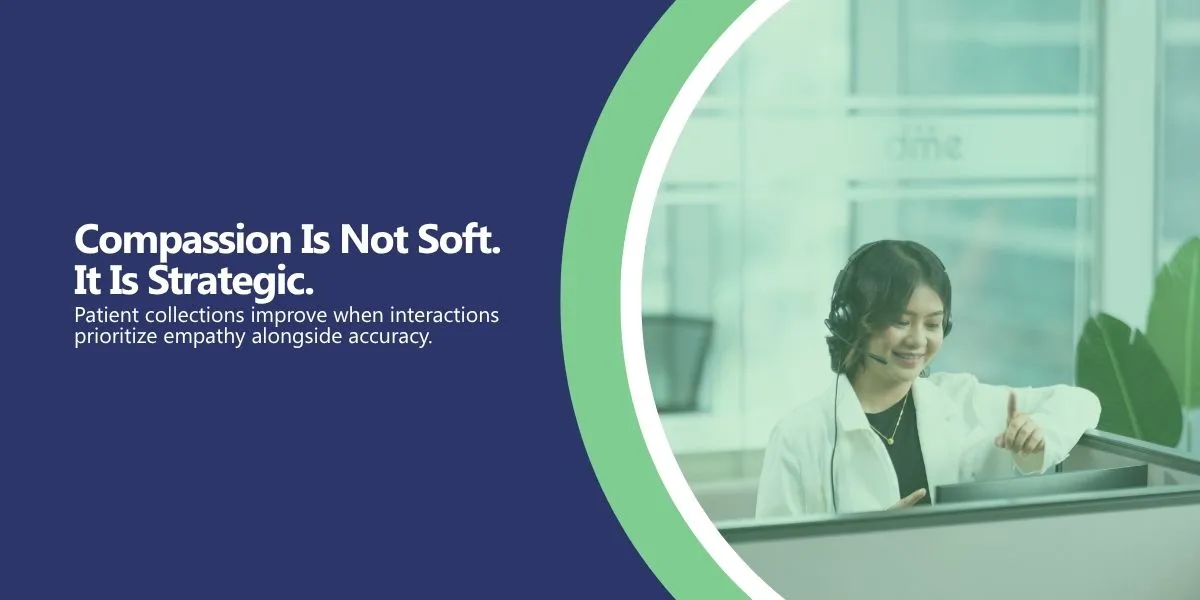
The organizations sustaining the highest collections rates do not optimize for volume. They optimize for patient experience. The distinction is subtle but consequential: when patient interactions are built on empathy, understanding, and genuine problem-solving, payment barriers dissolve naturally. Patients who feel heard are significantly more likely to pay than patients who feel pursued.
This is the Patient CX Multiplier: the outsized financial and operational impact of building collections workflows around compassion rather than coercion.
The Hidden Cost of Transactional Collections
The traditional collections model assumes patient resistance. Contact attempts are frequent. Language is formal. The implicit threat is escalation to agencies, to credit reporting, to larger financial consequence. The goal is to apply enough pressure that patients prioritize payment.
This approach works. It produces payment volume. But it comes with costs that transactional accounting often misses:
Patient Avoidance and Dropout When patients experience collections interactions as adversarial, they avoid future interactions with the organization. A patient who had a negative collection call is less likely to answer the next call. They are more likely to ignore billing statements. They are less likely to schedule future appointments or continue care relationships. The short-term collection gain creates long-term relationship loss.
Reduced Lifetime Value Patients are not one-transaction relationships. A patient who initiates care with a healthcare provider is typically engaged in an ongoing care relationship that spans years and generates multiple transactions. An aggressive collections interaction that secures one payment may cost multiple future transactions because the patient leaves the care relationship entirely.
Increased Write-offs and Bad Debt Patients who feel cornered are less likely to work with organizations on payment plans, work-arounds, or alternative solutions. They are more likely to simply abandon the balance. Many accounts that could have been recovered through flexible engagement end up as write-offs because the collection approach precluded dialogue.
Operational Friction and Attrition Agents who are trained to prioritize pressure over empathy experience higher burnout. They hear patient distress, frustration, and anger on every call. Over time, the emotional cost accumulates. Attrition in collections is notoriously high, often exceeding 50% annually, and a significant driver is the cognitive dissonance between the empathy required for effective communication and the pressure-based approach organizations expect.
The transactional collections model is optimized for speed, not sustainability.
The Patient CX Multiplier: How Empathy Changes Collections Outcomes
Compassion-driven collections operates from a different assumption: patients do not want to owe money. They face genuine financial constraints, confusion about what they owe, conflicting priorities, or legitimate disputes about charges. The interaction model shifts from pressure to problem-solving.
This reframing changes everything.
Empathy Lowers Resistance When a collections agent opens a conversation with genuine understanding rather than implicit accusation, patient defensiveness drops. A call that begins with “I understand insurance didn’t cover what you expected. Let me help you understand what you owe and what options we have” generates fundamentally different engagement than “Your account is past due. We need payment today.”
The first invitation invites dialogue. The second invites resistance.
When patients experience collections as problem-solving rather than confrontation, they are significantly more likely to engage, listen, and ultimately agree to payment terms.
Understanding Unlocks Barriers Many patients have legitimate barriers to payment that are invisible in standard collections protocols. A patient may not understand what they are responsible for versus what insurance should have covered. They may not realize a payment option exists. They may have a priority ordering that is different from the organization’s (housing payment before medical debt, for example). They may be waiting for a check, expecting insurance reimbursement, or dealing with a temporary financial crisis.
A collections interaction structured around understanding these barriers, rather than overriding them, creates opportunities for solution. A patient willing to set up a payment plan is a patient who will likely follow through. A patient offered a realistic timeline for payment is a patient who retains the relationship.
Consistency Reduces Avoidance Patients who have positive interactions with patient-facing staff early in their care journey are significantly more likely to respond to collections contacts later. A patient who experienced genuine care in intake, scheduling, or customer support develops trust in the organization. That trust extends to collections conversations. They are more likely to answer calls, respond to statements, and work through payment.
In contrast, a patient whose first substantive interaction with an organization is a collections call has no foundation of relationship to draw on. The barrier to conversation is higher.
This is why compassion-driven operations embed patient experience discipline across the entire patient journey not just in clinical care, but in intake, billing, and collections.
Payment Plans Replace Write-offs One of the clearest metrics of compassion-driven collections is the percentage of accounts settled through payment arrangements versus written off. When collections interactions include genuine dialogue about ability to pay, organizations typically see dramatic improvements in payment plan acceptance and adherence.
A patient offered a payment plan they can actually sustain is significantly more likely to complete it than a patient who defaults because the initial payment demand was not realistic. The difference between a $500 payment and a zero-balance write-off is often simply whether the collections conversation included the question: “What is a realistic payment timeline for you?”
Building Collections Around Compassion: The Operational Framework
Compassion-driven collections is not anecdotal kindness. It is a structured operational discipline that changes how patient contact is designed, how agents are trained, and how performance is measured.
Patient Segmentation by Complexity, Not Aggression Rather than routing all past-due accounts to collections uniformly, compassion-driven organizations segment accounts by reason for non-payment and likelihood of engagement.
A patient who is waiting for insurance reimbursement requires a different interaction than a patient who genuinely cannot afford payment. A patient with good historical payment behavior who has one late balance requires different contact than a patient with chronic non-payment. A patient facing a temporary financial crisis benefits from a flexible arrangement. A patient disputing the charge requires a different resolution path.
The segmentation reduces inappropriate aggressive contact while focusing engagement energy on accounts most likely to respond to proactive dialogue.
Agent Training Centered on Listening Over Convincing Traditional collections training emphasizes closing techniques, objection handling, and persistence. Compassion-driven collections training emphasizes listening, problem-solving, and transparency.
Agents are trained to listen for the actual barrier: “Walk me through what happened here.” Agents are trained to explain clearly what the patient is responsible for and why. Agents are trained to offer genuine options, not false choices. Agents are trained to acknowledge difficulty without minimizing it.
This training is more demanding than transactional collections training. It requires emotional intelligence, clarity of communication, and genuine problem-solving skill. But it produces significantly higher engagement and payment rates because it creates conditions where patients are willing to participate.
Performance Measurement Beyond Payment Rate Transactional collections measures payment obtained per contact attempt. Compassion-driven collections adds secondary metrics: payment commitment adherence, patient satisfaction, account resolution rate, payment plan acceptance, and write-off rate.
These metrics reveal whether collections interactions are generating sustainable outcomes or short-term volume. An organization with a 40% payment rate and 60% write-off rate is extracting less value from collections than an organization with a 35% payment rate and 15% write-off rate, even though the payment rate is lower.
Measurement discipline focused on comprehensive resolution—not just contact volume—drives operational decisions toward compassion.
Escalation Reserved for Non-Engagement, Not Early Default One of the most damaging practices in collections is escalating accounts too quickly based on the principle that earlier escalation produces faster payment. In practice, early escalation often produces the opposite: patients escalate their own resistance, engage less, and are more likely to default or dispute.
Compassion-driven collections reserves escalation for accounts that have genuinely failed to engage, not for accounts that are simply in early delinquency. The framework is: engage, understand, offer options, follow up, escalate only if the patient is unresponsive after genuine engagement.
This approach often feels slower early on. It produces significantly faster resolution overall because the majority of accounts engage successfully and pay.
Where Patient CX Multiplier Impact Shows Up
The financial and operational impact of compassion-driven collections extends far beyond the collections function itself:
Cash Flow Velocity Organizations with compassion-centered collections see faster payment resolution on past-due accounts because payment plans are accepted and completed at higher rates. The average days to payment is lower because patients are willing to prioritize resolution when the interaction is respectful.
Patient Lifetime Value Patients who experience compassionate collections interactions are significantly more likely to continue care relationships with the organization. They return for future appointments, recommend the organization to others, and generate multiple transactions over time. The cost of that one compassionate collections interaction is offset many times by the extended care relationship.
Operational Efficiency Collections agents working in compassion-centered environments experience lower burnout, take fewer sick days, and have higher retention. The reduction in turnover training and retraining costs alone often offsets the higher training investment required for compassion-driven skill development.
Reputation and Referral Patient experience in collections interactions influences how patients and referring providers perceive the organization. A patient who experienced respectful collections engagement, even if they could not pay immediately, is more likely to recommend the organization than a patient who experienced aggressive contact. This reputation effect extends to referral patterns and organizational credibility.
Reduced Debt Servicing When organizations reduce reliance on external collections agencies and aggressive escalation, they reduce the cost of bad debt management. Internal compassion-driven resolution is less expensive than external agency escalation.
The Role of Outsourcing in Compassion-Driven Collections
For healthcare organizations scaling patient engagement, outsourcing the collections function to a partner aligned with compassion-driven values becomes strategically important.
An outsourced collections partner who understands the difference between transactional and relational engagement brings several advantages:
Cultural Consistency A partner whose organizational culture prioritizes empathy and compassion extends that value into patient-facing collections interactions. Their agents are hired, trained, and measured on criteria that include patient experience, not just payment volume. This consistency is difficult for organizations to achieve with variable internal hiring and pressure-driven management.
Specialized Skill Development Compassion-driven collections requires specific skills: active listening, emotional intelligence, communication clarity, and problem-solving framing. An outsourcing partner specializing in healthcare patient engagement develops deep expertise in these skills. Agents are trained continuously in the nuances of empathetic engagement, not periodically in transactional collections techniques.
Separation of Pressure from Care When collections is internal, there is often pressure to align it with the clinical or care function, creating confusion about whether the organization is ultimately caring for patients or collecting from them. An external partner allows the organization to maintain the care identity while outsourcing the collections function to a specialized provider focused on that work with empathy.
Scalability Without Burnout Collections scaling creates burnout risk. Organizations that grow collections without proportional growth in specialized training and support often experience rapid agent attrition. An outsourcing partner with established compassion-driven frameworks can scale collections capacity without sacrificing quality or agent retention.
Real-World Outcomes: Compassion in Action
Healthcare organizations that have shifted collections to compassion-driven models report measurable results:
- Collections agents experience lower attrition because the work feels meaningful and manageable rather than adversarial
- Payment plans are accepted at significantly higher rates because patients understand the terms and perceive them as fair
- Write-off rates decline because resolution happens through dialogue rather than abandonment
- Patient satisfaction with collections interactions improves dramatically—many organizations report patients actually feeling valued by the conversation
- Escalations to external agencies decrease because internal compassionate engagement resolves most accounts
These outcomes are not anecdotal. They emerge consistently when organizations structure collections around patient experience rather than payment pressure.
Why Compassion Feels Risky (But Is Not)
One objection organizations often raise to compassion-driven collections is the assumption that empathy is soft, that “nice” collections will not produce payment. The concern is understandable. It is also contradicted by evidence.
Patients are not fundamentally payment-avoidant. They are avoidant of disrespect, unfairness, and confusion. When collections interactions provide clarity, respect, and realistic options, patients engage and pay. When interactions feel adversarial, patients disengage.
The risk of compassion-driven collections is not financial. It is cultural—it requires organizations to shift their identity from extractors to problem-solvers. That shift can feel like a loss of control. In practice, it produces better control because patient behavior becomes more predictable and responsive.
Final Thought
Patient collections is fundamentally a human interaction, not a financial transaction.
Organizations that optimize for the transaction often get sub-optimal results because they neglect the human element. Organizations that optimize for the relationship get superior financial and operational outcomes because they understand that payment follows engagement.
The Patient CX Multiplier is the compound effect of treating every patient interaction, including collections, as an opportunity to demonstrate that the organization’s commitment to care extends to how they handle difficult conversations.
When compassion guides collections, resistance dissolves. Payment accelerates. Relationships strengthen. And the organization’s financial and operational outcomes reflect the intelligence and humanity of that choice.
The best collections strategy is not pressure. It is presence.